You're heading down Route 28, the kids are in the back, and a little amber engine icon lights up on the dash. The car still drives fine. Should you panic? Pull over? Ignore it until tomorrow? Most drivers in Derry, Manchester, and the rest of southern New Hampshire have lived through this exact moment — and most have also been quoted wildly different numbers when they asked a shop to "check the code."
This guide walks you through what the check engine light actually means, when it's an emergency, and what a real check engine light diagnosis should look like at an independent shop. No scare tactics, no upsells — just the same answers we give friends and family who ask us.
01What the check engine light actually means
The check engine light (officially the Malfunction Indicator Lamp, or MIL) is your car's way of saying its on-board computer detected something outside the normal operating range. That's it. It doesn't say what, it doesn't say how bad, and it doesn't say how soon — it just says "something."
Behind that light is a system called OBD-II (On-Board Diagnostics, second generation). Every car sold in the U.S. since 1996 has it. When a sensor sees a reading it doesn't like — oxygen levels in the exhaust, misfires in a cylinder, evaporative emissions leaking from the fuel system — OBD-II stores a fault code (a "P-code" like P0420, P0301, or P0455) and turns the light on.
The code is a starting point for diagnosis, not the diagnosis itself. P0420 doesn't mean "replace the catalytic converter." It means "catalyst efficiency below threshold, bank 1" — which could be a bad oxygen sensor, a small exhaust leak, a misfire on one cylinder, contaminated coolant, or yes, eventually a worn-out converter. Same code, five different repairs, five very different bills. This is why a real diagnostic matters.
02Solid vs. flashing: how urgent is it?
The first thing to look at is whether the light is steady or flashing. This is the single most useful piece of information you can give a shop over the phone.
A flashing check engine light is an active misfire.
Unburned fuel is being dumped into the exhaust, which can destroy a catalytic converter in minutes of continued driving. If your light is blinking, get off the road safely, shut the engine off, and call a tow. A $40 tow can prevent a $1,200+ converter replacement.
A steady light is far more common and rarely an emergency. Your car can usually be driven safely to your shop or even finish the workday, as long as you aren't noticing other symptoms (loss of power, overheating, smoke, hard starting, unusual smells). The light is telling you "schedule a diagnostic in the next few days" — not "stop right now."
03The 7 most common reasons the light comes on
Out of the hundreds of possible OBD-II codes, a handful account for the vast majority of check-engine-light visits we see at the shop. Knowing these doesn't replace a real diagnostic, but it helps you walk into the conversation informed.
1. Loose or failed gas cap (EVAP system)
Codes like P0440, P0442, and P0455 trip when the evaporative emissions system can't hold pressure — and a loose, cracked, or worn gas cap is the cheapest, most common cause. Tighten the cap until it clicks at least three times. If the light goes out after a few drive cycles, you just saved yourself a service visit.
2. Oxygen sensor (O2 sensor)
Codes in the P0130–P0167 range usually point here. Oxygen sensors measure the exhaust mix and tell the computer how much fuel to inject. They wear out gradually around 80,000–120,000 miles. A failed O2 sensor hurts fuel economy long before it becomes drivable trouble.
3. Catalytic converter efficiency (P0420 / P0430)
The big scary one. But, as noted above, P0420 is often caused by a failing upstream O2 sensor, a small exhaust leak, or a chronic misfire — not a worn converter. A good diagnostic rules those out first instead of jumping straight to the most expensive part.
4. Spark plugs, ignition coils, or a misfire (P0300–P030x)
P0300 means "random misfire." P0301 means "misfire on cylinder 1," P0302 cylinder 2, and so on. The cause is usually a worn spark plug, a failing ignition coil, or a fuel injector issue. Catch this early — sustained misfires destroy catalytic converters fast (see section 02).
5. Mass airflow (MAF) sensor
P0101–P0104. The MAF tells the computer how much air is entering the engine. When it gets dirty (common after a long oil-soaked air-filter life) the engine runs rich or lean and feels hesitant. Sometimes a careful cleaning fixes it; sometimes it needs replacement.
6. EGR valve / EGR system
P0400-range codes. The EGR system recirculates a small amount of exhaust to reduce emissions. Sticking valves and clogged passages are common on higher-mileage vehicles — especially those that mostly do short trips around town and never burn the carbon off on a longer drive.
7. Thermostat / coolant temperature sensor
P0125, P0128. Common in cars that have lived through a few New Hampshire winters. The engine isn't reaching or holding proper operating temperature. Often a stuck-open thermostat — an inexpensive part that, ignored, kills fuel economy and accelerates wear.
04Why a free parts-store "code read" isn't a diagnosis
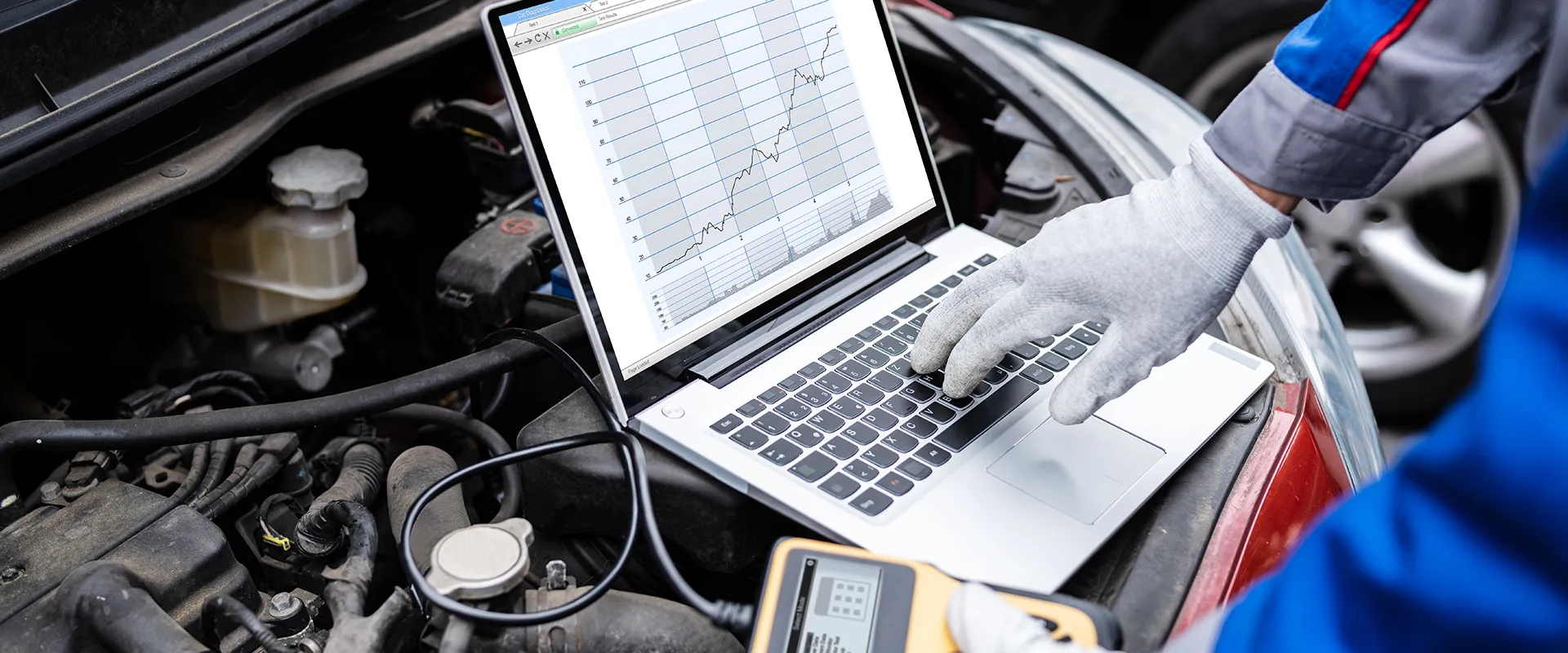
The big-box parts stores will read your code for free. That's a useful first step — and it's also why so many drivers in southern New Hampshire end up paying for the wrong repair. A code read gives you a P-code. A diagnostic tells you what actually caused it.
Here's a typical example we see weekly: a driver gets P0420 read at the parts counter, types it into Google, sees "catalytic converter" everywhere, and walks into a shop asking for a $1,200 cat. After 30 minutes on a real scan tool we find a failing rear O2 sensor (a ~$220 repair) triggering a perfectly healthy converter to report low efficiency. Same code, fraction of the cost, problem actually solved.
A real automotive diagnostic includes:
- Full OBD-II scan across all modules — engine, transmission, ABS, airbag, body electronics — not just the powertrain.
- Live data and freeze-frame review — what the sensors were reading at the exact moment the code set.
- Pending and history codes — the codes that almost triggered the light, which often point at the real underlying problem.
- Hands-on verification — a visual inspection of vacuum lines, wiring, connectors, and physical components the code implicates.
- Test-driving where appropriate, especially for intermittent or drivability complaints.
05What a check engine light diagnosis should cost in southern NH
Diagnostic fees in the Derry / Manchester / Salem area generally fall in the $95–$165 range for a typical engine-light concern. Anyone offering a "free check engine diagnosis" is either reading codes for free (different thing) or recouping that time inside an inflated repair quote. A real diagnostic takes 30–90 minutes of trained-technician time on a $7,000 scan tool — that's not free, and you don't want it to be.
At Vorenza, the diagnostic fee gets credited back against the eventual repair when you have the work done with us. That's how it should work everywhere: you pay for honest investigation, and once you choose to fix the problem, the investigation effectively becomes free. If a shop refuses to put the diagnostic in writing or rolls it into a "we'll figure it out" estimate, that's a flag.
| What you got | What it tells you | Typical cost |
|---|---|---|
| Free parts-store code read | The headline P-code only. No live data, no history, no inspection. | $0 |
| "Quick scan" at a quick-lube | P-codes and a generic suggestion. Usually no time spent verifying the cause. | $0–$50 |
| Real diagnostic at an independent shop | Full scan + live data + freeze-frame + hands-on verification. Written estimate with the actual fix. | $95–$165 |
| Dealer diagnostic | Manufacturer-level scan tool. Often more thorough on brand-specific quirks, but priced highest. | $150–$220+ |
06When you can keep driving — and when you absolutely can't
Most check engine lights are not emergencies. But a few specific combinations are. Use this as a quick triage at the curb.
Probably safe to drive to your shop (steady light only)
- Light came on, but the car drives, idles, and accelerates normally.
- No new noises, no smoke, no warning lights other than the check engine light (our guide to dashboard warning lights covers the rest).
- Temperature gauge sits where it normally does. Oil pressure is normal.
- You just filled the tank and the light came on within a drive or two (possible loose gas cap).
Don't drive — call for a tow
- Flashing check engine light. Active misfire, risk to the catalytic converter.
- Check engine light plus the red oil-pressure or temperature light. Either can destroy an engine in minutes.
- Burning smell, smoke from the exhaust, or coolant smell inside the cabin.
- The car is bucking, surging, stalling, or losing power on acceleration.
- You hear a knocking, ticking, or rattling that wasn't there before.
Cold-weather false alarms are real.
In the deep cold of a Derry winter, expect a few "nuisance" lights — thermostat-related codes (P0128) and EVAP codes (P0440-series) trip more often when temperatures swing 40°F in a day. If your light came on after the first sub-zero morning of the year and the car drives fine, it's worth scheduling a check, but it isn't usually an emergency.
07How to avoid the three most common diagnostic upsells
A handful of common upsells get pitched on check-engine-light visits all over southern New Hampshire. None of them are scams exactly — they're just sold harder than they should be. Watch for these.
1. "You need a new catalytic converter."
Sometimes true. Often premature. Insist that the shop rules out O2 sensors, exhaust leaks, and misfires first. A real diagnostic spends 30 minutes confirming the cat is actually bad, not 30 seconds reading P0420 and pulling a part off the shelf.
2. "We should just replace all the O2 sensors."
Most cars have 2–4 oxygen sensors. Replacing all of them at once is a $400–$900 shotgun fix that usually isn't needed. The scan data tells you which sensor is misbehaving — replace that one, drive it, then re-check.
3. "Your spark plugs are due, while we're in there."
Spark plugs are a real maintenance item. But on most modern cars they last 60,000–100,000 miles. If you're at 38,000 miles, you almost certainly don't need them. Ask for the manufacturer's published interval, not the shop's preference.
08Local note: what we see across Derry, Manchester & southern New Hampshire
We pull codes on a lot of cars every week. A few patterns specific to southern NH driving:
- Short commutes are hard on EGR and EVAP systems. A lot of our customers do 4–7 mile drives to work in Derry, Londonderry, or Salem. Engines don't always reach full operating temperature, carbon builds up, and emissions codes set sooner than the mileage would suggest. A longer highway drive every couple of weeks genuinely helps.
- Salt-belt corrosion shows up in exhaust codes. Cars in their second New England winter onwards often see small exhaust leaks at flex pipes and rusted heat shields. These can trip P0420 and O2-related codes without anything actually being wrong with the converter or sensors.
- Battery age affects diagnostic accuracy. A weak battery causes intermittent low-voltage codes across modules — codes that look serious but disappear after a battery test and replacement. We always check battery health on a diagnostic visit — here's how to tell when a battery actually needs replacing.
- "Reset and see if it comes back" isn't a strategy. Resetting the code without fixing the cause means it comes back — usually right after you've paid for the visit and driven away.
If you're in Derry, Manchester, Londonderry, Salem, Windham, or anywhere in southern New Hampshire and your check engine light just came on, we'd rather you stop in for an honest diagnostic than guess at parts on a forum. Call (603) 825-3815, send a message through our contact form, or stop by the shop at 15 Central St, Unit B, Derry, NH 03038. Bring the codes if a parts store already pulled them — it saves time.