
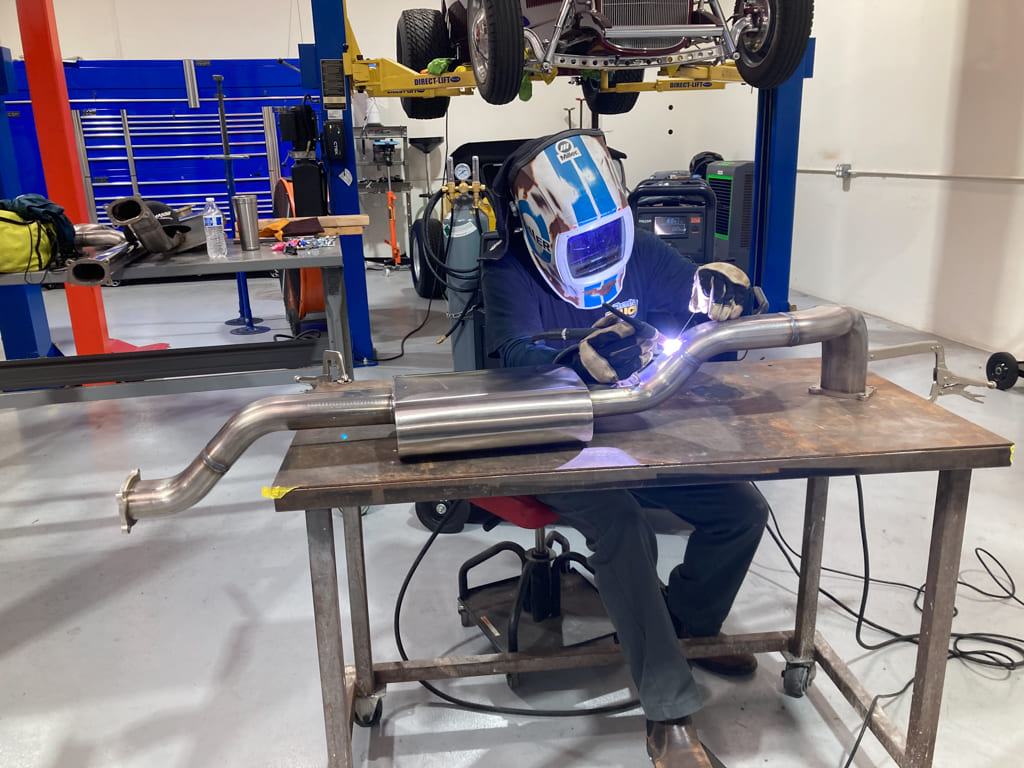
Nobody schedules an exhaust appointment because a light came on. You schedule it because one morning your car sounds like a different car — and every neighbor on the street now knows exactly what time you leave for work. If that's you, you're in the right place. Exhaust repair in Derry, NH is one of the most common jobs that rolls into our bay, and it is almost never bad luck. It's the predictable result of driving a good car through eight or ten New England winters. At Vorenza Auto Repair, here's how we tell a five-minute weld from a real replacement — and how you can tell before you ever call.
Why New Hampshire is so hard on exhaust systems
Your exhaust doesn't rust from the outside in. It rusts from both directions, and our winters supply the ammunition for each.
From below, there's the salt. Southern New Hampshire spends months under salt and brine, and every mile you drive throws that slurry up into the underbody, where it settles into every seam and hanger on the exhaust. From the inside, there's water — burning fuel produces it, and a hot exhaust normally boils it straight out the tailpipe. But a short winter commute never gets the pipe hot enough to do that. So the water pools in the muffler and the low spots of the pipe, mixes with the salt working in from outside, and quietly eats the metal while the car sits in your driveway overnight.
Short trips are the problem. A ten-minute drive from Derry to the store barely warms the exhaust — so the moisture stays in it.
Salt does the rest. Months of brine, splash, and freeze-thaw work into every seam under the car.
The result: a car driven mostly on short local errands can rot an exhaust out years earlier than the same car in a dry climate — even with low mileage on the odometer.
This is also why the material matters when you do replace it. Coated mild steel is the factory standard and a sensible value pick if you're keeping the car a few more years. Stainless — 409 for the best price-to-life ratio, 304 for a show-quality polish — gives you real corrosion resistance against exactly the salt and slush we drive in. We'll walk you through the trade-off honestly rather than defaulting you to the most expensive option — and if you're upgrading rather than repairing, our guide to cat-back vs axle-back exhaust covers the choices.
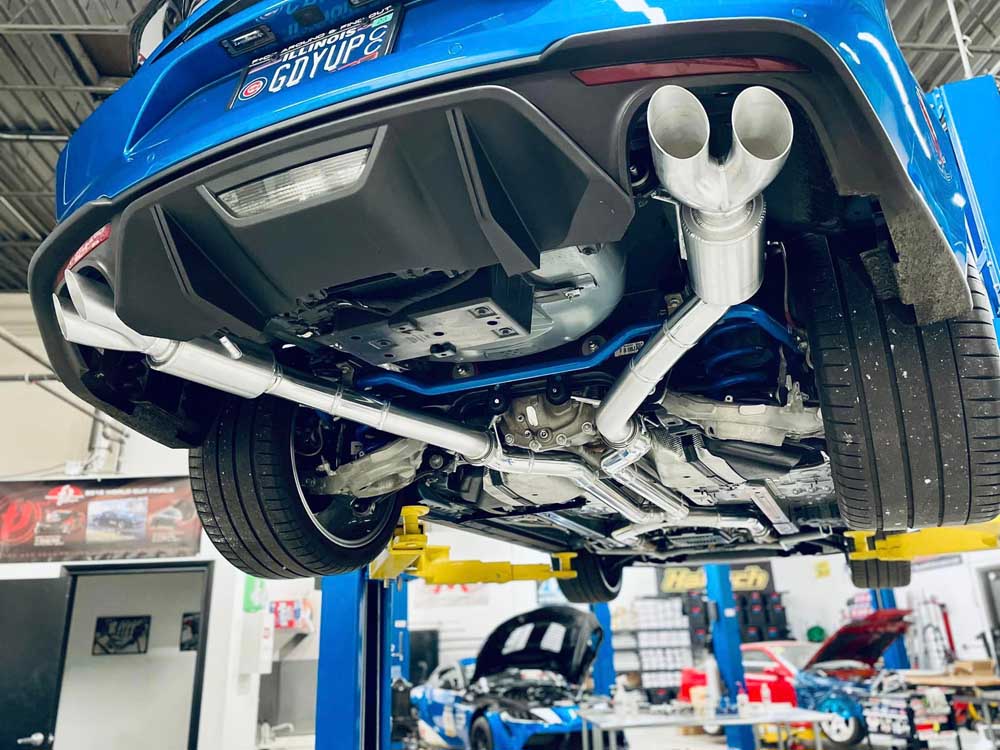
The only honest way to diagnose an exhaust is from underneath — on a lift, with the system cold and in your line of sight.
6 signs you need exhaust repair
You don't need a lift to catch most of these. You just need to know what you're listening for.
→It got loud, and it got loud suddenly
Exhaust systems fail all at once. Rust thins the metal for years with no symptom, then a section finally opens up and the noise arrives overnight. A deep rumble at idle that wasn't there a month ago is the single most common reason drivers call us — and it usually means a hole, not a "worn out" muffler.
→A drone or hum that shows up at highway speed
If the car is tolerable around town but sets up a droning hum at 60 on I-93, that's a resonance problem — often a failed internal baffle in the muffler, a leaking joint, or a section of pipe that's lost its shape. It's the kind of thing you stop noticing until you get out of the car with a headache after the commute into Manchester.
→You can smell exhaust inside the car
This is the one that isn't about noise, and it's the one to act on today. A leak ahead of the passenger cabin — a cracked manifold, a blown gasket, a hole in the front pipe — can push exhaust gas up into the car instead of out the back. Carbon monoxide is colorless and odorless on its own, so the smell you notice is your warning that gas is getting in where it shouldn't. Don't drive it and don't air it out with the windows. Call us.
→The check engine light came on with it
Your engine decides how much fuel to inject based on what the oxygen sensors read in the exhaust stream. A leak upstream of a sensor feeds it fresh air and throws the reading off — so an exhaust problem shows up as a running problem. A failing catalytic converter has its own signature codes, P0420 and P0430. If your light is on, our guide to check engine light diagnosis walks through what the codes actually mean before anyone starts replacing parts.
→Something rattles, scrapes, or hangs low
A metallic rattle that changes with engine speed is usually a loose heat shield or a broken hanger letting the pipe knock against the floor. Ignore it and the system eventually drags. If you caught yours on a frost heave or a bad pothole, that's a common way a rusted hanger finally gives up — the same territory we cover in our pothole damage inspection guide.
→Your fuel economy quietly slipped
When a leak skews the oxygen sensor data, the engine compensates by running richer than it needs to. You won't feel it. You'll just notice you're filling up a little more often than you used to, and you'll probably blame gas prices. It's worth a look.
Repair it or replace it? The question that actually decides the bill
This is where an independent shop and a parts-swapping chain part ways. A dealer or a quick-lube counter tends to quote the whole assembly, because replacing a complete system is simple to price and simple to sell. Often it's overkill.
Here's the honest rule we work by:
- A repair makes sense when the failure is a discrete part on otherwise healthy metal — a cracked weld, a blown gasket, a leaking flange, a broken hanger. We fix the failure and you keep your exhaust.
- A section replacement makes sense when one stretch has rusted through but the rest of the system is solid. We cut out the bad length and weld in new mandrel-bent pipe.
- A full replacement makes sense only when the metal is thin and flaking end to end. Patching that is throwing money away, because you'd be welding onto rust — the patch holds and the pipe tears open right next to it a few months later.
That last point is the one worth remembering. If someone welds a plate over a hole in a pipe that's already gone soft, you will be back. We'd rather tell you the truth about which of the three you're looking at than sell you the wrong one twice.
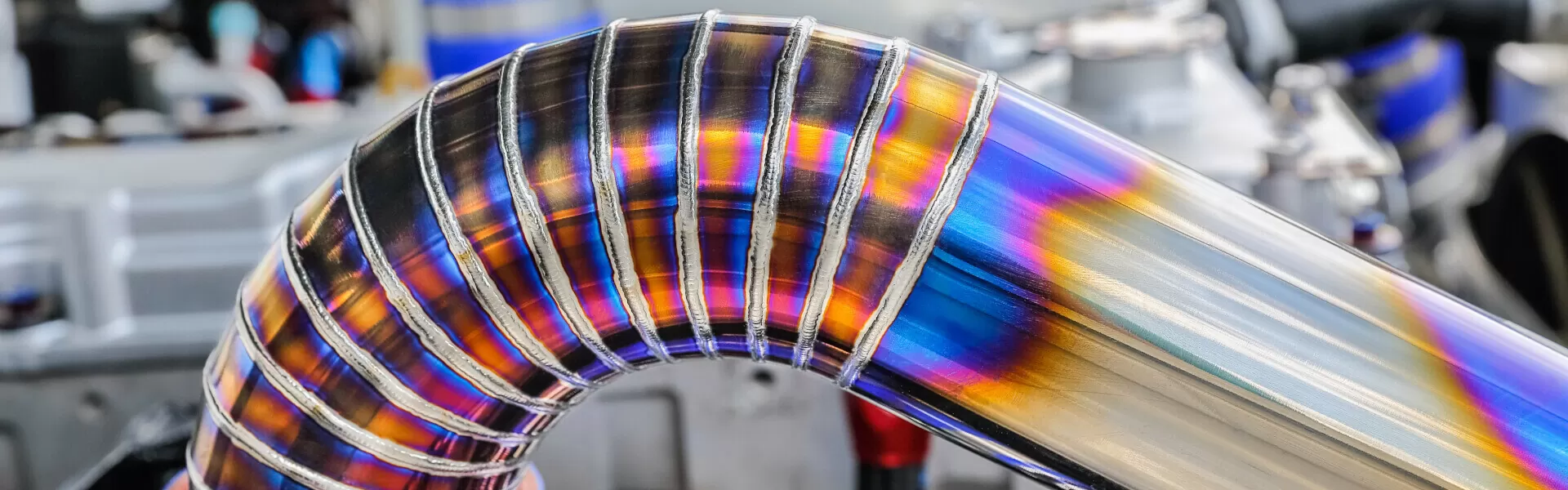
Every system that leaves our shop is mandrel-bent and TIG-welded in-house — not contracted out to a third party.
Because we bend and weld our own pipe, we're not limited to whatever direct-fit part a catalog happens to stock for your vehicle. That matters most on older cars, trucks, and anything modified, where "the part" may not exist anymore — we can simply make it. You can see the full range on our custom exhaust and fabrication page, from leak sealing and rust-out sections to catalytic converters and mufflers.
What exhaust repair in Derry, NH actually costs
We publish our prices wherever a job has one — and we won't pretend exhaust work does. It genuinely ranges from sealing a single flange to replacing a catalytic converter, and any shop quoting you a firm number over the phone, before anyone has looked underneath your car, is guessing. What we can promise is how you'll find out:
| Service | Price |
|---|---|
| Exhaust inspection & written estimate On the lift, with the system cold. We show you the rot before we quote it. | Free |
| Exhaust repair, muffler, or catalytic converter Quoted in writing after the inspection — and backed by our 12-month / 12,000-mile warranty. | Written quote |
| Brake pads & rotors Published, because this job has a real starting price. | from $299/axle |
| Oil change (up to 5 quarts) $8.95 per additional quart. Includes a courtesy multi-point inspection. | from $89.95 |
Nothing gets done to your car until you've seen the estimate and said yes. If we find the fix is smaller than you feared, you'll hear that too — it's the same approach behind every repair we do across Derry, NH, and every covered job from our general repair team carries a 12-month / 12,000-mile warranty on parts and labor.
Exhaust repair FAQs — from drivers in Derry, Manchester & Southern NH
What are the symptoms of an exhaust leak?
The most common symptoms are a sudden increase in engine noise (a rumble or roar that wasn't there last month), a droning hum at highway speed, an exhaust or rotten-egg smell inside the cabin, a check engine light, a rattle or scrape from underneath, and falling fuel economy. A smell inside the car is the one to act on immediately — an exhaust leak ahead of the cabin can let carbon monoxide in, and carbon monoxide is colorless and odorless on its own.
Why do exhaust systems rust out so fast in New Hampshire?
Road salt. Southern New Hampshire spends months of the year under salt and brine, and it collects on and inside your exhaust. The system also rusts from the inside out: short winter trips never get the pipe hot enough to boil off the water that combustion naturally produces, so that moisture sits in the muffler and pipes and mixes with the salt spray coming from below. That's why a car driven mainly on short Derry and Manchester commutes can rot an exhaust out years earlier than the same car driven in a dry climate.
Can you just weld the hole instead of replacing the whole exhaust?
Sometimes, and when it's the right call we'll tell you. A cracked weld, a blown gasket, or a leaking flange on otherwise solid pipe is a genuine repair. But if the surrounding metal is thin and flaking, a weld will simply tear out again next to the patch, because you're welding to rust. In that case we replace the rusted section with new mandrel-bent pipe. What we won't do is sell you a full system when a section will do.
How much does exhaust repair cost in Derry, NH?
It depends on what's actually failed, which is why we don't publish a single number for it — exhaust work ranges from sealing one leaking flange to replacing a catalytic converter. We put the car on the lift, show you the rot, and give you a written estimate before any work starts, free. For reference on how we price, our published figures are brake pads and rotors from $299 per axle and oil changes from $89.95, and covered repairs carry a 12-month / 12,000-mile warranty on parts and labor.
Is it safe to drive with a loud exhaust?
Treat a loud exhaust as a problem to book, not to ignore. If you can smell exhaust inside the car, stop driving it and call us — that's a carbon monoxide risk, not just a noise complaint. If it's loud but you smell nothing, it's usually safe to drive it to the shop, but the hole will keep growing and a hanging pipe can drop. Either way it gets more expensive the longer it waits, because rust spreads along the pipe.
Bottom line: the noise is information, not an annoyance
A loud car is easy to live with for a while. You turn the radio up, you tell yourself you'll deal with it in the spring, and the hole keeps growing — because rust doesn't stop spreading just because you've gotten used to the sound. The cheapest version of this repair is almost always the one you book when you first hear it.
If your car has started announcing itself on the way out of the driveway, get it looked at by someone who will show you what's actually wrong. That's what exhaust repair in Derry, NH should look like: your car on a lift, the rot in front of you, an honest recommendation, and a written number before anyone picks up a torch.
Ready to get it sorted? Call (603) 825-3815, email support@vorenzarentals.com, or use our contact form to book an exhaust inspection. We're at 15 Central St, Unit B, Derry, NH 03038, open daily 8am–6pm by appointment, serving Derry, Manchester, Londonderry, Salem, Windham, and southern New Hampshire.