
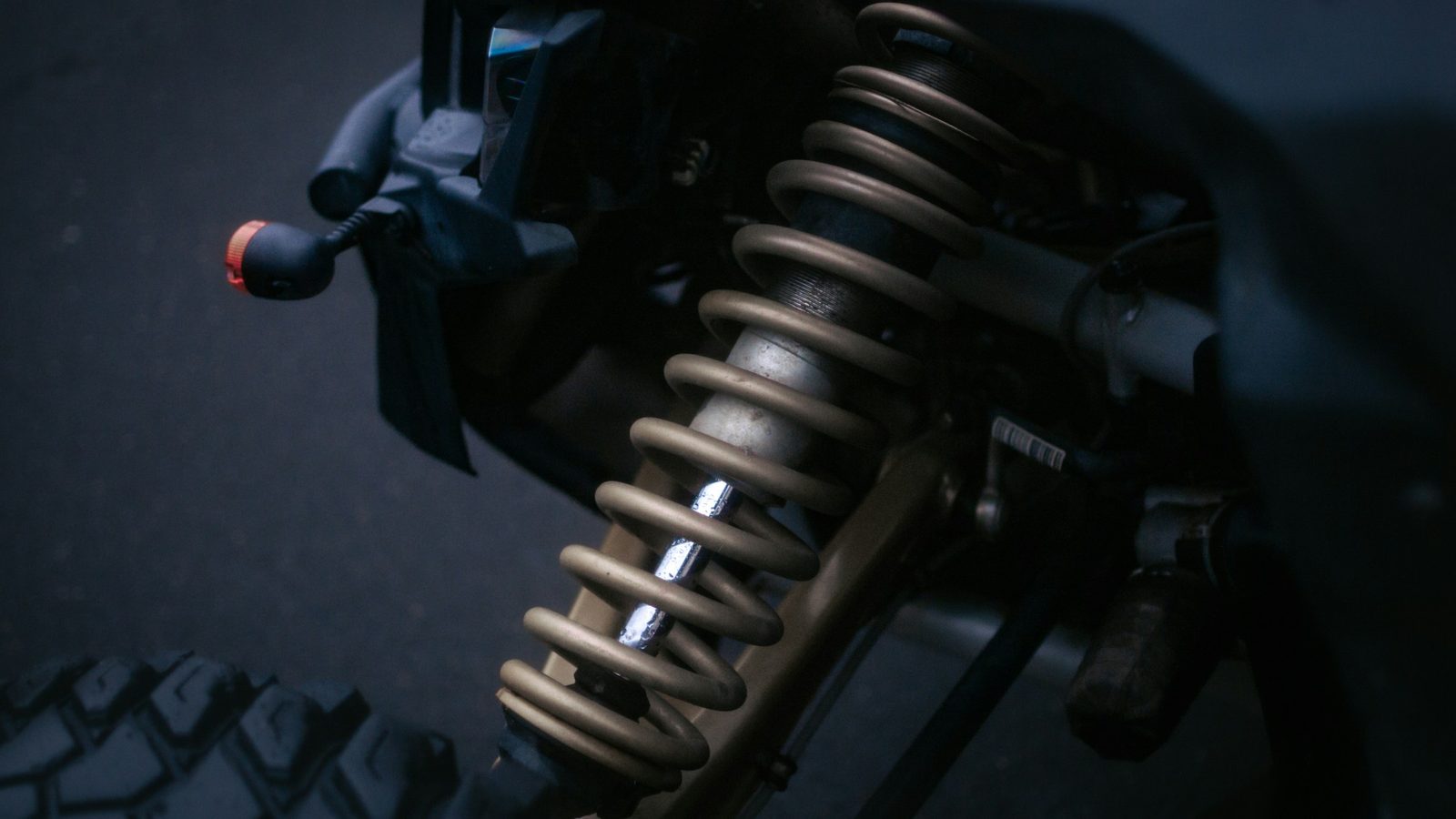
The first sign is almost never dramatic. You come off Exit 4 onto Route 102, roll over the same frost-heaved seam you cross every morning, and something up front goes clunk — once, quietly, in a way it didn't last winter. Two months later the car floats over dips and the front tires are wearing in patches. Most requests for suspension repair in Derry, NH start right there: not with a breakdown, but with a noise the driver has been explaining away since March. At Vorenza Auto Repair we put those cars on a lift most weeks, and the honest answer is that some need parts now and some just need watching. Here is how to tell which one you're driving.
Why New Hampshire roads wear out struts and shocks early
Most manufacturers put struts and shocks somewhere in the 50,000 to 100,000 mile range. That number assumes a road surface southern New Hampshire does not have. Three local realities move the timeline forward, and none of them show up on a dashboard.
Freeze-thaw builds the roads that break suspensions
Water gets into a pavement crack, freezes overnight, expands, and lifts the surface. It thaws by afternoon and the road drops back down slightly out of shape. Do that a few dozen times between December and April and you get the frost heaves and broken edges that define a New Hampshire commute in March. Every one of those is an impact the suspension absorbs so you don't. Struts are consumable for the same reason brake pads are — they are designed to take the hit.
Road salt goes after the parts you can't see
Brine doesn't just rust body panels. It sits on the shock body, works into the rubber bushings at every control arm and sway bar link, and dries out the boots that keep grit off the strut rod. Rubber that has been salted for eight winters gets hard and cracks; once a bushing is split, the joint moves in a direction it was never meant to move, and that's the clunk. This is the same corrosion story we cover in getting your car ready for a New Hampshire winter, playing out on parts nobody thinks about.
The southern NH commute is mostly highway miles
A car running Derry to Manchester on I-93, or out Route 101 toward the seacoast, puts on real mileage quickly. Highway miles are gentler per mile than city miles — but there are simply more of them, and they're taken at the speeds where a worn damper matters most. A seven-year-old commuter here can easily be at 130,000 miles on original struts.
6 signs you need suspension repair in Derry, NH
None of these requires a lift to notice. If you have two or more, it's worth getting the car looked at before winter rather than after.
→A clunk or knock over bumps that wasn't there last year
The most common complaint we hear, and the least specific. A single metallic knock over expansion joints and frost heaves usually points at a sway bar end link, a split control arm bushing, or a failing strut mount. It's rarely urgent on its own — but it's information, and it tends to be the cheapest thing on this list to fix if you catch it early.
→The car keeps moving after the bump is over
A shock's only job is to stop the spring from oscillating. When it's worn, the body keeps bobbing after a dip instead of settling in one motion. You'll feel it most on a rolling back road or coming off a driveway apron. Push down hard on a front corner and let go: the car should rise and settle. If it bounces two or three times, that damper is past it.
→The nose dives hard under braking
Some forward pitch is normal. A car that plunges onto its front bumper in ordinary traffic braking has front struts that are no longer controlling weight transfer. This one is worth taking seriously, because it changes how the car behaves in the stop you didn't plan for — more on that below.
→Cupped or scalloped tire wear
Run your hand around the tread. If it feels like a scallop shell — high, low, high, low around the circumference — the tire has been bouncing rather than rolling, and the damper is why. This is the sign that costs you money twice: once for the suspension, once for the tires it ruined. Catching it early is the difference.
→Oil or wet grime streaking down the strut body
A strut is a sealed oil damper. When the seal lets go, the oil that provides the damping runs down the outside of the tube and collects road dust in a dark streak. A light film is normal weeping; a wet stripe with dirt caked to it means the strut is done. You can often see this through the wheel spokes with the wheel turned to full lock.
→The car wanders or feels loose at highway speed
Constant small steering corrections to hold a lane on I-93, or a car that gets pushed around noticeably by a passing truck, can be worn suspension rather than an alignment problem. Aligning a car with a loose ball joint or tie rod end is money spent twice — the angles drift straight back out. Any honest shop inspects the front end before it sets the rack.
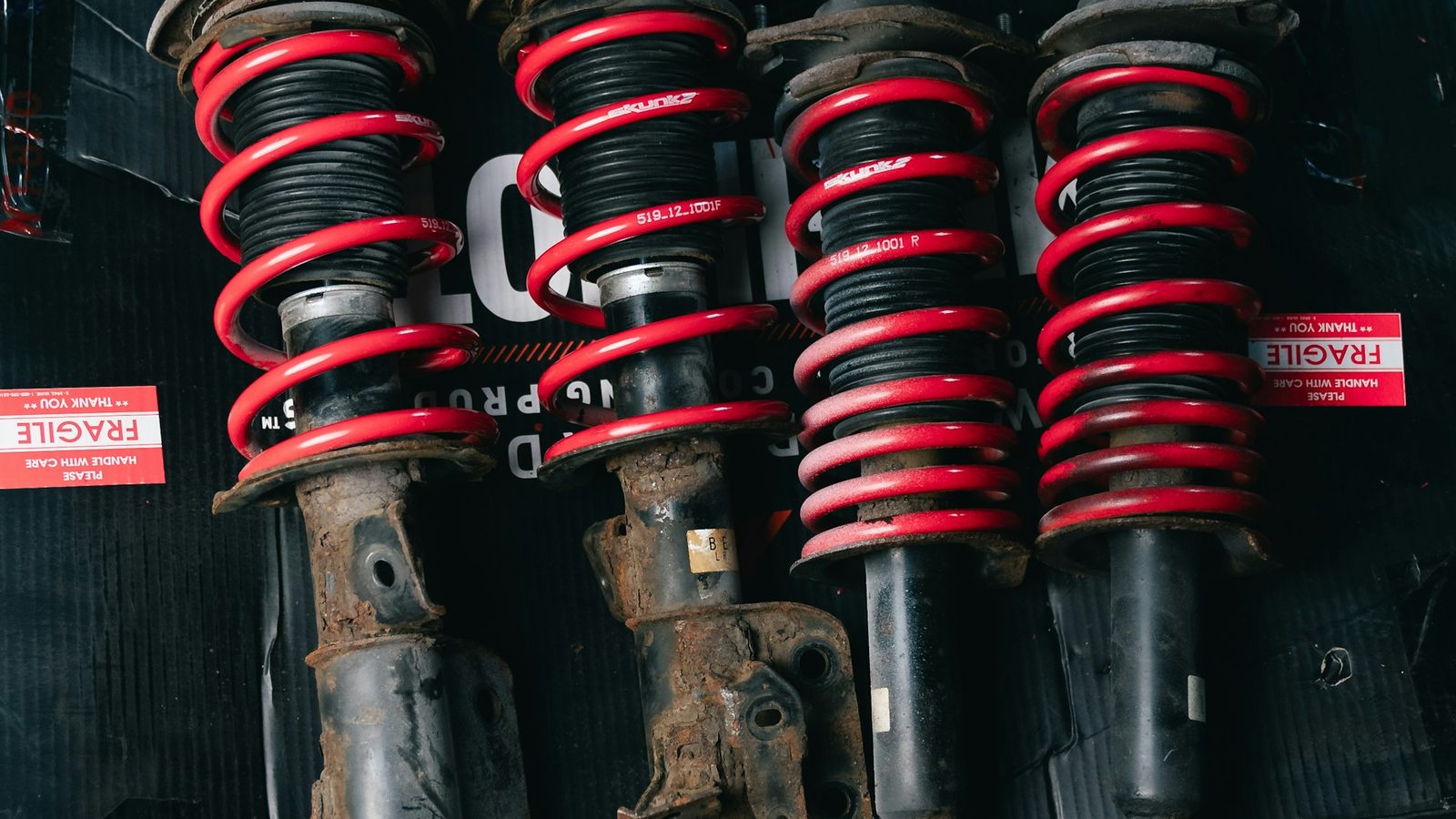
Left: struts pulled from a high-mileage commuter after years of salt exposure. Right: their replacements. Nothing here failed suddenly — the damping just faded, a little each winter, until the driver stopped noticing what normal felt like.
The part most drivers miss: worn shocks lengthen your stopping distance
Suspension gets sold as a ride-comfort item, which is why it's the repair people put off longest. That framing is wrong, and here's the mechanism.
Your brakes cannot use grip the tire doesn't have. Grip comes from the contact patch — the few square inches of rubber actually touching the road at any instant. Over a bump, the spring lifts the wheel; the shock's job is to push it back down and keep it planted. When the damper is worn, the wheel skips instead, and the contact patch flickers in and out of existence. Your ABS is then modulating pressure to a tire that keeps leaving the pavement.
On smooth, dry asphalt you may never notice. On a frost-heaved stretch of Route 28, a wet on-ramp, or the packed snow that shows up here in November, you're asking for maximum grip on exactly the surface where worn dampers cost you the most. Excessive nose-dive compounds it by unloading the rear tires right when you need them. It's the same reason we treat brakes and suspension as one system rather than two line items: pads and rotors from $299 per axle can only work as well as the suspension holding the tires down. Our 2026 Derry brake repair cost guide breaks down that side of the job line by line.
Pothole hit or worn out? How to tell them apart
These are two different repairs that produce overlapping symptoms, and the distinction changes what gets quoted. The short version: impact damage arrives all at once, wear arrives so slowly you adapt to it.
- You can name the moment. If the noise or pull started the afternoon you hit something hard on Route 102, that's impact damage — a bent rim, a knocked-out alignment angle, or a cracked bushing. Our guide to pothole damage after a New Hampshire winter walks through those five signs specifically.
- You can't name the moment. If a friend borrowed the car and mentioned the ride, or you noticed the tire wear before you noticed anything else, that's wear. It's usually symmetrical — both fronts, both rears — because both sides aged together.
- Both can be true. A pothole is what finally breaks a bushing that eight winters had already hardened. The impact gets the blame; the salt did the work.
We inspect the same way in either case: on a lift, loading each joint by hand, checking the dampers for leaks and the tires for the wear pattern that tells the real story. If the noise turns out to be a rusted exhaust hanger knocking against the underbody — and it sometimes is, because it sounds identical from the driver's seat — you'll be told that, not sold a strut. That's what our vehicle diagnosis service is for: finding the cause before anyone quotes a part.
What suspension repair in Derry, NH actually costs
We publish starting prices for the services that have one. Suspension work doesn't, and we'd rather say so than post a number that means nothing: a single sway bar end link and a pair of loaded strut assemblies are not the same job on any vehicle. What you get instead is an inspection, a written estimate with parts and labor broken out, and your approval before anything starts.
| Service | Price |
|---|---|
| Suspension & steering repair Struts, shocks, springs, control arms, ball joints, sway bar links and bushings. Inspected on the lift and quoted to your vehicle on a written estimate. | custom quote |
| Multi-point courtesy inspection Included with every maintenance visit. Covers steering and suspension components, fluids, brakes, and tire wear. | included |
| Brake pads & rotors Per axle. Premium pads, rotor resurfacing or replacement, caliper inspection and service, brake fluid check, and a post-repair road test. | from $299/axle |
| Oil change (up to 5 quarts) New oil, OEM-spec filter, and a courtesy multi-point inspection included. | from $89.95 |
| Each additional quart For trucks, SUVs, and larger engines that hold more than 5 quarts. | $8.95 |
Every figure above is a starting price on an estimate you approve first, and covered repairs carry a 12-month / 12,000-mile warranty on parts and labor. Full details are on our auto repair page, and the courtesy inspection comes with any visit to our maintenance and oil change service.
When you bring a car in for a suspension complaint, ask the technician to show you the part on the lift and demonstrate the play by hand. A worn ball joint or a split bushing is obvious once someone points at it, and thirty seconds under the car tells you more than any explanation at the counter. We do this by default at 15 Central St, Unit B — but ask for it anywhere you take your vehicle.
Suspension repair FAQs — from drivers in Derry, Manchester & Southern NH
How long do struts and shocks last in New Hampshire?
Most manufacturers put struts and shocks in the 50,000 to 100,000 mile range, but that assumes smooth pavement. Southern New Hampshire is the hard end of that band: freeze-thaw cycles break the road surface open every spring, road salt attacks the shock body and the rubber bushings around it, and a lot of local miles are highway miles on I-93 and Route 101. We routinely find worn units well before 100,000 miles on cars that have never been abused. Mileage is a prompt to look, not a verdict — the inspection is what tells you.
Can I keep driving with a worn strut or shock?
For a short time and at moderate speed, usually yes — a worn strut is a wear item, not an immediate breakdown. What it is not is harmless. A worn damper lets the tire skip rather than stay planted, which lengthens your stopping distance, makes the car less stable in an emergency lane change, and scallops your tires into an early replacement. If the strut is leaking oil, a spring is broken, or you hear a metallic clunk on every bump, get it looked at that week rather than that season.
Do struts and shocks have to be replaced in pairs?
Across an axle, yes — replace both fronts or both rears together. A new damper on one side and a worn one on the other gives you uneven damping across the axle, which the car expresses as pulling under braking and uneven tire wear. Front and rear are separate decisions, though. If your fronts are done and the rears still test fine, we will tell you that and quote the fronts only.
Does a bad suspension affect braking distance?
Yes, and it is the reason we treat suspension as a safety item rather than a comfort item. Your brakes can only use the grip the tire has on the road. A shock's job is to keep that tire pressed to the pavement over bumps; when it is worn out, the wheel bounces and the contact patch comes and goes. On a frost-heaved road or an icy on-ramp that means less grip exactly when you are asking for the most. Worn struts also let the nose dive harder under braking, which unloads the rear tires and makes the car feel unsettled.
Is a clunking noise over bumps always the suspension?
No, and that is worth knowing before you authorize any work. A clunk over bumps can be a sway bar end link, a worn control arm bushing, a strut mount, a loose ball joint — or a rusted exhaust hanger letting the pipe knock against the underbody, which sounds identical from the driver's seat. That is why we put the car on a lift and load the joints by hand instead of guessing from the symptom. You get a written estimate for what we actually find.
Does Vorenza Auto Repair do New Hampshire state inspections?
No — we are not a licensed New Hampshire state inspection station. We do perform a thorough multi-point courtesy inspection on every visit, plus pre-purchase inspections, and steering and suspension components are part of what we check. If something is borderline, you will know about it before it shows up on someone else's sticker. For the official state safety inspection you will need a licensed inspection station.
How much does suspension repair cost in Derry, NH?
Suspension work is quoted to your vehicle rather than sold off a price list, because a sway bar end link and a pair of loaded strut assemblies are not remotely the same job. We inspect on the lift, break out parts and labor on a written estimate, and get your approval before anything starts. Published starting prices for our other services are on the site: brakes and rotors from $299 per axle, oil changes from $89.95 for up to 5 quarts and $8.95 per quart after that. Covered repairs carry a 12-month / 12,000-mile warranty on parts and labor. Call (603) 825-3815 for a quote.
Bottom line: a suspension doing its job is one you never think about
That's what makes it easy to ignore. Nothing lights up, nothing strands you, and the decline is slow enough that most drivers recalibrate to it without noticing. Then one November morning there's frost on the on-ramp and the car doesn't settle the way it used to. Getting suspension repair in Derry, NH looked at in September rather than January is not an upsell — it's just the cheaper half of the same conversation.
Hearing a clunk, seeing cupped tires, or watching the nose dive? Call (603) 825-3815, email support@vorenzarentals.com, or use our contact form to book. We're at 15 Central St, Unit B, Derry, NH 03038, open daily 8am–6pm by appointment, serving Derry, Manchester, Londonderry, Salem, Windham, and southern New Hampshire.